
Surface Prep Deep Dive

Diamond Grinding vs. Acid Wash:
Why Prep Is 80% of the Job

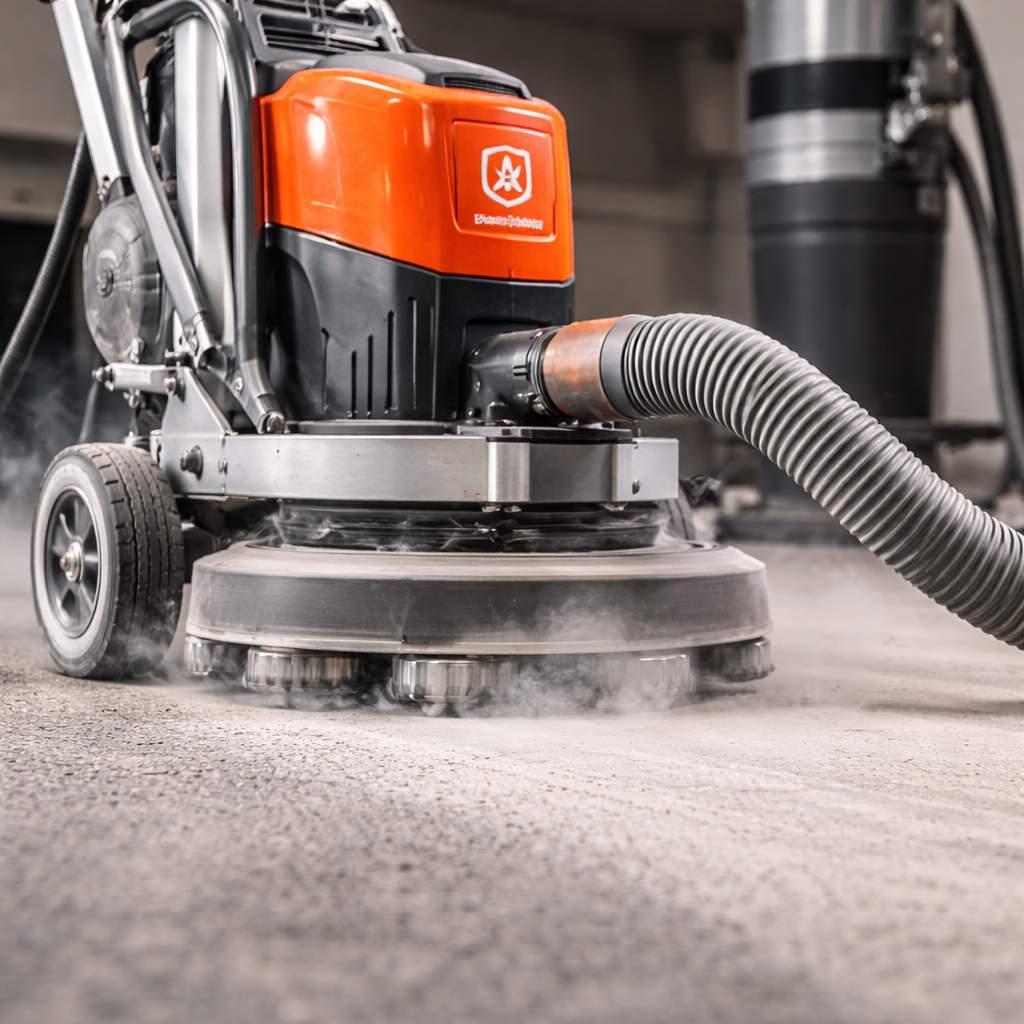
The best epoxy in the world fails on a poorly prepared surface. Every professional floor that peels in Irvine, Anaheim, or anywhere across Orange County traces back to the same root cause: the wrong surface profile. Here's the science behind why diamond grinding is the only method we use.

What Is Concrete Surface Profile (CSP)?

The International Concrete Repair Institute (ICRI) defines Concrete Surface Profile (CSP) as a standardized measurement of surface texture - the microscopic "roughness" of concrete that allows coatings to anchor mechanically. The scale runs from CSP 1 (nearly smooth) to CSP 9 (heavily scarified). For garage floor epoxy systems, CSP 3 is the industry benchmark.

Close-up of CSP 3 concrete surface profile achieved via diamond grinding
1

CSP 1 - Lightly Etched

Produced by light acid washing or grinding. Suitable only for thin, decorative sealers. The profile is too shallow to anchor a structural coating under thermal stress. This is what most DIY projects achieve - and why they fail.

Not Suitable for Epoxy
2

CSP 2 - Acid Etch

Typical result of professional acid etching. Slightly better than CSP 1, but still insufficient for industrial coatings under hot-tire conditions. The profile depth (6-13 microns) cannot support the mechanical demands of an Orange County garage floor.

Insufficient for OC Heat
3

CSP 3 - Diamond Ground

Achieved only by diamond grinding with the correct tooling and pass speed. Profile depth of 25-40 microns. Opens the concrete's capillary pore structure, removes laitance and contamination, and creates a true mechanical tooth for 100% solids epoxy to grip. This is the ArmorClad standard.

ArmorClad Standard

Why CSP Matters More in Orange County Than Almost Anywhere Else

Orange County concrete - particularly in inland communities like Anaheim Hills and Irvine - is often laid with a hard, dense surface finish that resists adhesion. The intense SoCal sun bakes a micro-carbonation layer onto exposed slabs over time, creating a nearly invisible barrier between the concrete and any coating. Acid wash has no mechanical means to remove this layer. Diamond grinding at CSP 3 physically removes it, exposing fresh, reactive concrete beneath.

What Actually Happens When We Diamond-Grind Your Slab

It's not just "roughing up the surface." It's a systematic mechanical treatment that transforms your concrete at the molecular level.

  1. 1

    Surface Assessment and Contamination Mapping

    Before grinding begins, our crew maps the slab for oil stains, curing compounds, previous coatings, efflorescence, and high-spot variations. This determines the correct diamond tooling grit and machine weight for your specific concrete. Irvine HOA homes and Anaheim Hills slab ages receive different tooling profiles - there is no one-size-fits-all approach.

    Diagnostic Phase
  2. 2

    Laitance Removal

    Laitance is the weak, cement-rich layer that migrates to the surface during concrete placement. It looks solid but has virtually no tensile strength. Any coating bonded only to laitance will delaminate under stress - not because the epoxy failed, but because the substrate itself failed. Diamond grinding removes laitance completely and is the only prep method that reliably does so.

    Critical Step
  3. 3

    Capillary Pore Opening

    Concrete's internal pore structure is what allows epoxy to penetrate and form a mechanical lock. The CSP 3 grinding profile opens these pores to their optimal diameter for 100% solids epoxy infiltration. When the epoxy cures inside these pores, it creates thousands of micro-anchors per square inch - this is why a properly ground floor cannot be peeled off even with mechanical force.

    The Bond Mechanism
  4. 4

    Profile Verification at 25-40 Microns

    After grinding, the surface profile is verified against the CSP 3 standard using replica putty impressions. This isn't done by eye - it's a measurable, documentable standard. Our installers do not proceed to the coating phase until the slab meets spec. For Irvine HOA projects where documentation is required, this profile record is part of the job file.

    Quality Control
  5. 5

    Crack and Spall Repair Before Coating

    Grinding reveals every crack, spall, and control joint that needs remediation before any epoxy is applied. On older Fullerton concrete and historic homes across Orange County, this step is often extensive - and skipping it is the second most common cause of premature coating failure after inadequate surface profile. The ArmorClad system addresses structural defects first, always.

    Structural Prep

The Acid Wash Shortcut - and Why It Fails in Orange County

Muriatic acid wash is faster, cheaper, and requires no specialized equipment. That's why many budget installers use it. The acid reacts with the calcium carbonate in the cement matrix, producing a modest etch. But it has three fundamental problems that diamond grinding doesn't share.

First: Shallow profile. Even aggressive acid washing produces CSP 1-2 at best. For 100% solids epoxy, this is insufficient. The high-viscosity resin doesn't penetrate deeply enough to form a durable mechanical bond. The coating sits on top of the surface rather than inside it.

Second: Contamination remains. Acid cannot remove oil, grease, or curing compounds that have penetrated the concrete. It neutralizes the surface chemistry briefly, but the contamination is still there - and it will telegraph through the coating as delamination spots over time. Diamond grinding physically removes the contaminated layer.

Third: Residue problems. Acid leaves calcium salt residue (efflorescence) that must be fully neutralized and rinsed before coating. If any acid residue remains - a common problem with DIY acid washing on OC slabs - it continues reacting beneath the epoxy, causing blistering and delamination from below.

Diamond Grinding vs. Acid Wash: At a Glance

  • Profile depth: 25-40 microns (grinding) vs. 3-8 microns (acid)
  • Laitance removal: Complete vs. Partial at best
  • Contamination removal: Yes - physical removal vs. No - contamination stays
  • Pore opening: Full capillary access vs. Surface-only chemistry
  • Residue risk: None vs. Acid salt residue under coating
  • Suitable for 100% solids: Yes vs. No
  • Required for ArmorClad: Yes - CSP 3 mandatory vs. Not acceptable
Built on a Diamond-Ground Foundation

The ArmorClad Industrial System Requires CSP 3

The ArmorClad system was engineered from the ground up to leverage the full mechanical bond that only diamond grinding delivers. It is not compatible with acid-wash prep - and that's by design.

  • Diamond-grind CSP 3 prep on every single project - no exceptions
  • 100% solids epoxy base coat penetrates the opened pore structure
  • Mechanical bond rated for hot-tire conditions at 200°F in OC heat
  • Crack and spall remediation before coating - always included
  • Applied by ArmorPoxy System Specialists who verify profile before proceeding
  • Used on Irvine HOA homes, Anaheim Hills garages, Newport Beach showrooms
See the Full 5-Step Installation

Surface Prep Specifications

ArmorClad CSP 3 Standard

Required CSP CSP 3 (25-40 microns)
Method Diamond Grinding Only
Laitance Removal 100% - Verified
Pore Condition Open, Contaminant-Free
Crack Repair Before Coating Begins
Acid Wash Never Used

More from the Knowledge Hub

DIY vs. Industrial Epoxy

Even with perfect surface prep, the wrong coating chemistry fails. Learn why 100% solids industrial epoxy outperforms every water-based DIY kit sold in Orange County.

Read the Article

Stop Hot-Tire Pickup

Great prep and great chemistry still need to withstand OC heat. Learn the physics of hot-tire failure and how the ArmorClad system prevents it.

Read the Article

Don’t Let Poor Prep Destroy Your Investment

Every ArmorClad installation starts with professional diamond-grind prep to CSP 3 - verified before a single drop of epoxy is mixed. Serving Irvine, Newport Beach, Anaheim, Fullerton, and all of Orange County.

Get a Professional Grade Quote for Your OC Garage

ArmorPoxy System Specialist  |  100% Solids Guarantee